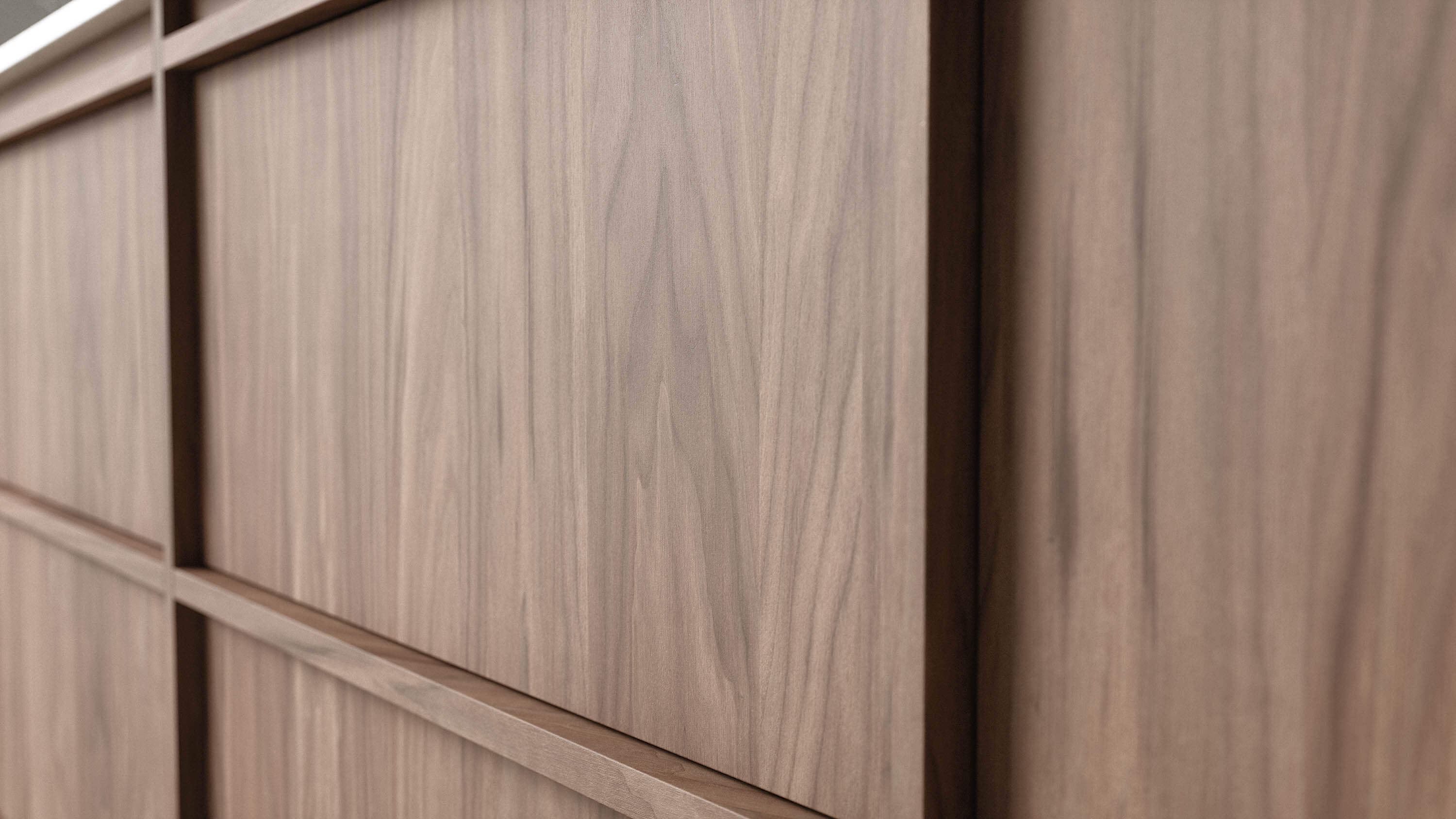
There’s a common assumption that veneer is somehow inferior to solid wood. That if a piece isn’t carved from thick lumber, it must be a compromise. This assumption overlooks what veneer actually is, and why it was so widely used in mid-century furniture.
Veneer is real wood.
It’s a thin slice of walnut, teak, oak, maple, or another species, cut directly from a log and applied to a stable core. The grain is real. The variation is real. The depth is real. It can be oiled, toned, and (carefully) refinished because it is wood.
Mid-century designers didn’t use veneer as a shortcut. They used it for precision.
Veneer allowed makers to create seamless grain across wide surfaces, book-matched drawer fronts, mirrored cabinet doors, and clean architectural planes that solid lumber alone can’t reliably deliver. It also provided dimensional stability, reducing the risk of warping or splitting over time.
Veneer is often confused with other surface materials, but they’re not the same thing.
Laminate, for example, is a synthetic layer designed to resemble wood. It’s durable and practical, but it isn’t wood. It can’t be sanded, stained, or restored in the way real wood can. And many contemporary, mass-produced pieces use printed foil or thermo-wrapped finishes over composite board. These are purely decorative surfaces. Once damaged, they cannot be restored.
Veneer belongs in a different category entirely, and understanding that distinction changes how you evaluate vintage furniture.